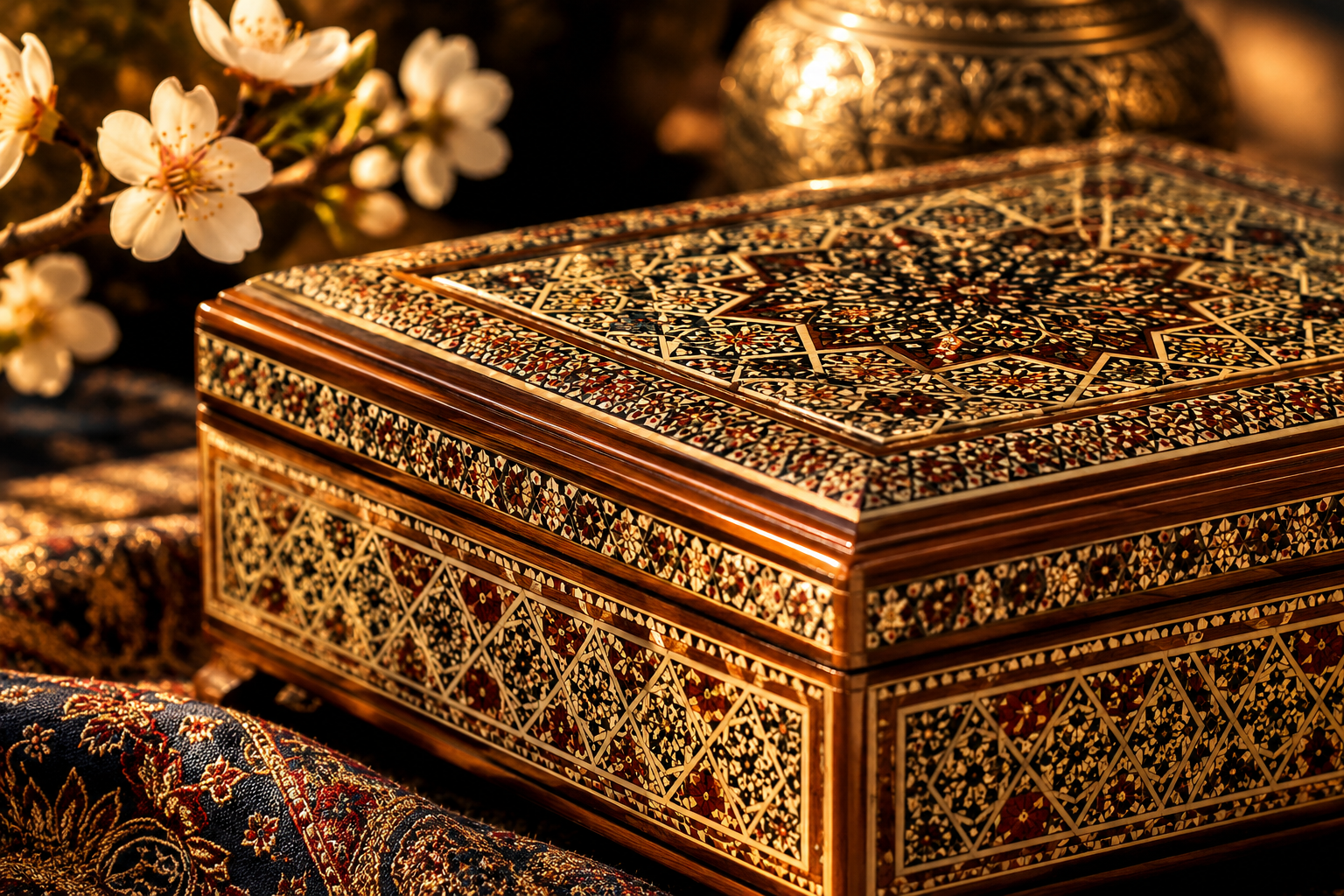
At first glance, a piece of Persian khatamkari may look like a surface covered in delicate stars, tiny polygons, and shimmering lines. Look closer, and the surface begins to reveal its true nature: it is not a drawing placed upon wood, but a world carefully constructed from hundreds of small elements. Each fragment has a place; each line depends on another. The beauty emerges from their relationship.
Khatamkari, often described in English as Persian marquetry or inlay work, is one of Iran’s most intricate decorative crafts. It transforms slender pieces of contrasting wood, bone, and metal into repeating geometric patterns, bringing material, mathematics, and the human hand into a single artistic language.
A History Written in Many Hands
The precise beginnings of khatamkari are not easy to assign to one date or workshop. Related forms of inlay and geometric woodwork have long histories, and accounts of the craft’s early development do not always agree. What is clearer in the historical record is the importance of Shiraz and Isfahan as centres of khatam production. The Encyclopaedia Iranica identifies khatamkari as a speciality of both cities from the Zand period in the second half of the eighteenth century. Earlier and later periods also shaped the wider tradition of Persian decorative arts, while workshops, patrons, and changing tastes influenced how the craft developed.
In time, khatam appeared on objects both intimate and monumental: boxes, frames, furniture, writing instruments, musical instruments, doors, and architectural details. Its presence on an object did more than decorate it. It signalled the value of skilled labour, considered design, and the time invested in making.
How a Pattern Is Built Before It Is Seen
The distinctive logic of khatamkari lies in its method. The craftsperson prepares very thin rods or strips from materials with different colours and tones. Wood may provide warm browns and deep blacks; bone creates pale contrasts; brass or other metals introduce fine reflective lines. The exact materials vary by period, workshop, and object.
These slender elements are shaped, arranged, and bound together into carefully planned bundles. The bundles are then cut across their length into thin slices. Each slice carries the same small geometric arrangement, like a cross-section of a pattern that has been built in three dimensions before being transferred to a surface. The slices are placed side by side on a wooden object, forming a continuous field of stars, polygons, and interlocking lines. The surface is then levelled and polished so that the separate pieces become a unified whole.
This process requires more than a steady hand. It demands an ability to imagine how a pattern will appear before it is assembled, to control minute differences in material and thickness, and to maintain precision through many repetitive stages. A small error can interrupt the rhythm of the design.
The Geometry of Detail
Geometry in khatamkari is not an academic decoration added after the work is complete. It is the structure that makes the work possible. Repetition, symmetry, proportion, and the meeting of lines determine how the surface holds together. The eye may first notice the stars, but the deeper achievement is the balance between the individual motif and the larger field.
There is also a particular visual intelligence in the way contrasting materials are used. Light and dark, warm and cool, matte and reflective elements create depth without relying on perspective or illusion. The pattern seems to move as the viewer changes position, while the underlying structure remains precise.
Patience as a Form of Knowledge
Khatamkari offers a lesson that reaches beyond the workshop. It shows that complexity does not always come from a single grand gesture. Sometimes it is created through the thoughtful arrangement of many modest parts. No single fragment carries the entire beauty of the object; the beauty exists in the care with which the fragments are brought together.
That does not mean the craft should be reduced to a metaphor. Its value is first material and human: the knowledge of preparing, joining, cutting, fitting, and finishing; the sensitivity to wood and metal; and the experience passed from one maker to another. Yet the process also invites reflection. It reminds us that precision can be expressive, repetition can be creative, and patience can become a visible form of intelligence.
A Living Tradition, Not a Frozen Relic
Preserving khatamkari does not mean keeping it outside contemporary life. A living craft must be understood, practised, taught, and allowed to evolve without losing the integrity of its technique. Contemporary designers can learn from its geometry, material contrasts, and disciplined approach to detail. New applications may emerge, but the difference between authentic inlay and a surface that merely imitates its appearance should remain clear.
In a world shaped by speed and mass production, khatamkari asks us to look again at the value of time, skill, and material honesty. It is not simply an object from the past. It is evidence of what human hands can create when knowledge, imagination, and patience work together.
Where Many Pieces Become One
Perhaps the most enduring beauty of khatamkari lies in this quiet transformation: separate fragments become a coherent surface without losing their individual character. The pattern does not erase difference; it gives difference a relationship and a place.
That is where patience becomes art—not in slowness alone, but in the ability to make every small element matter.
Explore the Persian edition: هنر خاتمکاری؛ هندسهای از صبر، دقت و زیبایی
recent posts
Discover khatamkari, the intricate Persian art of geometric inlay, where wood, bone, and metal become finely balanced patterns through patience, precision, and skilled craftsmanship.

What lies beyond the reality we perceive? Explore the hidden mysteries of the universe, the limits of human knowledge, and the endless journey of discovery.

Discover why patience is more than waiting—and how time, awareness, and quiet perseverance shape a meaningful life.
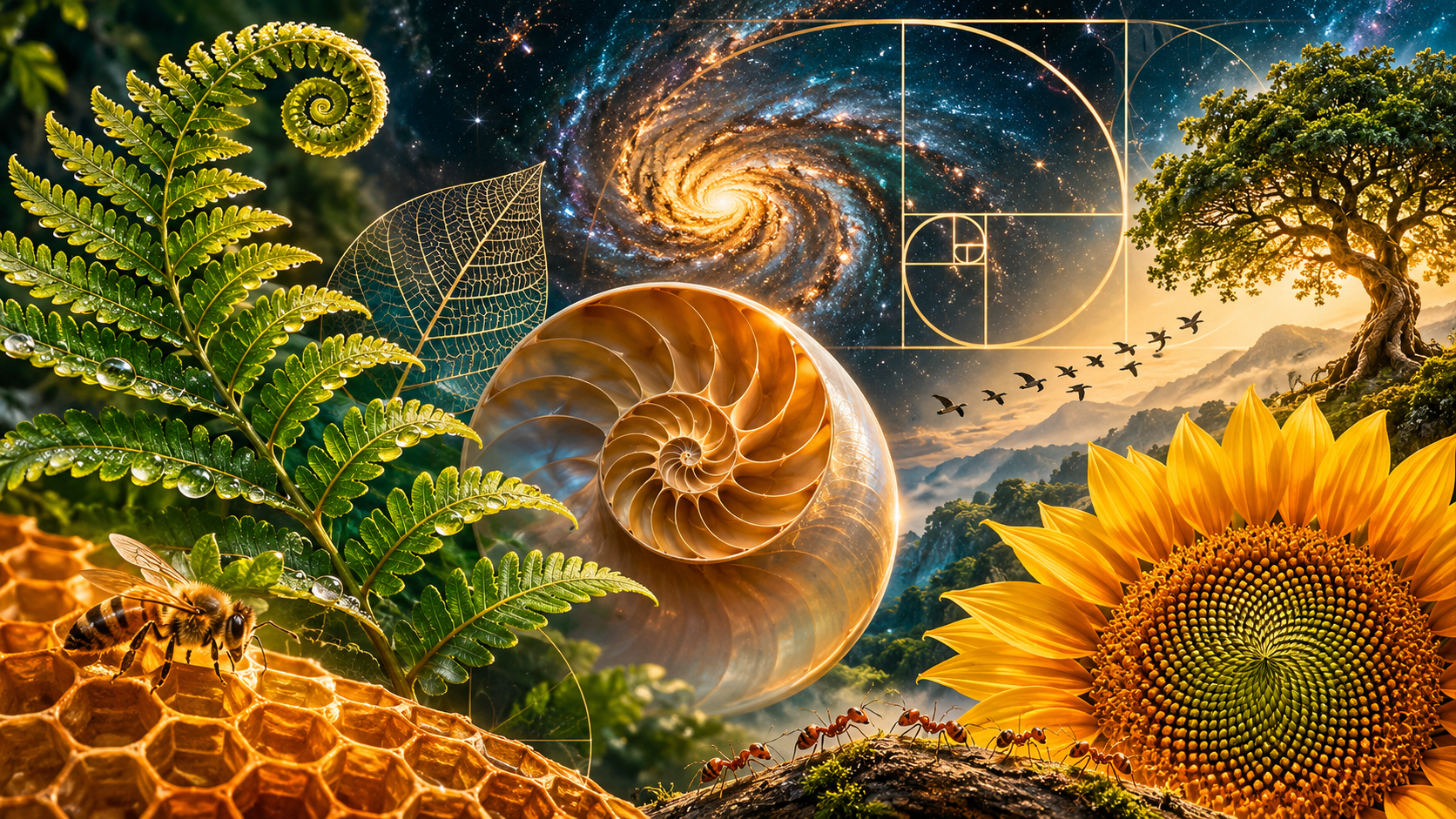
Discovering the extraordinary principles of order, intelligence, and self-organization in ...

Love is more than an emotion. It is a transformative force that awakens creativity, expands awareness, and shapes who we are becoming.

Is love more than an emotion? Explore love as a human way of recognising connection, creating meaning, and nurturing life through philosophy, nature, and art.
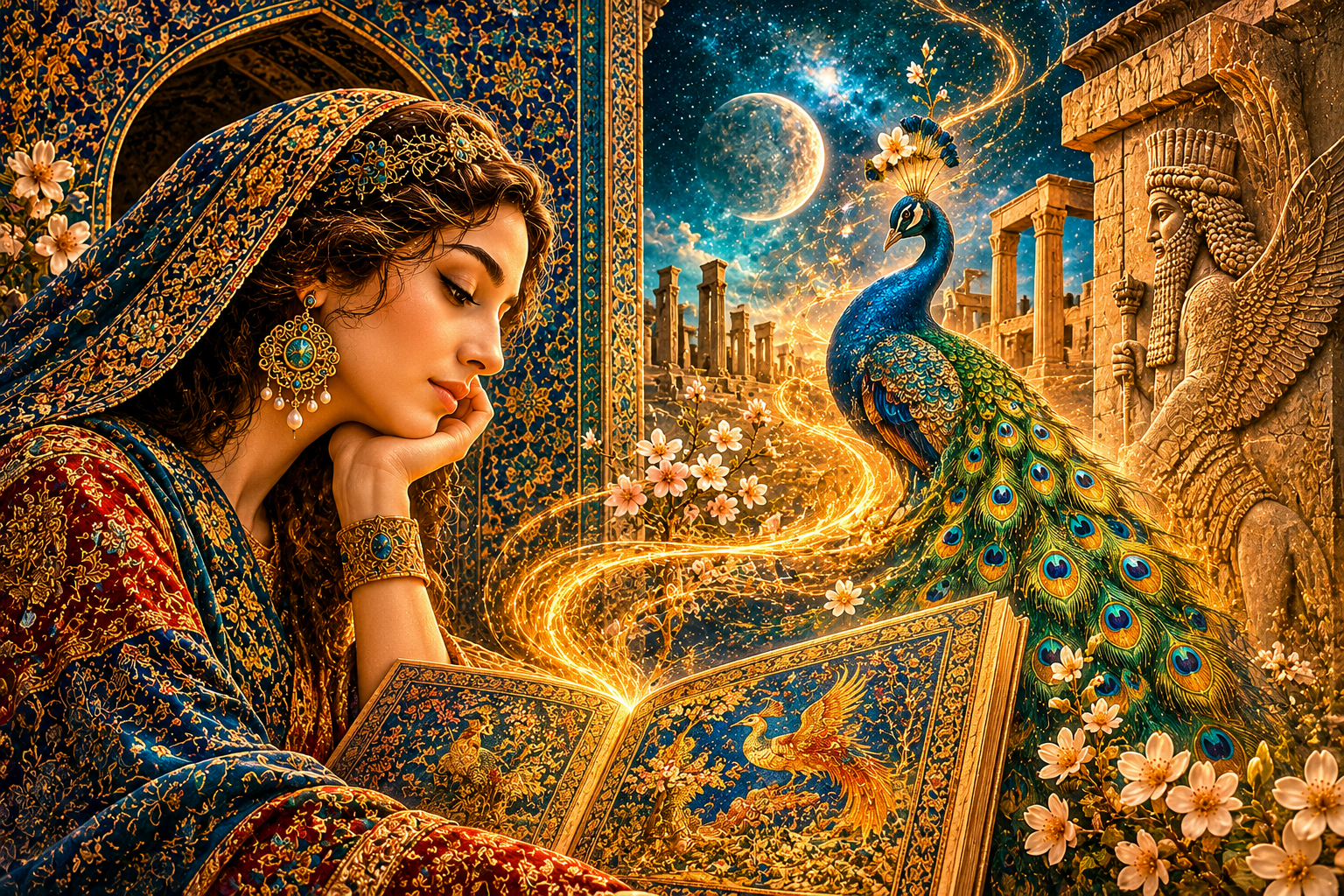
Explore the symbolic language of Persian art—from gardens and birds to miniature painting and geometric patterns—and discover how cultural meaning can inspire thoughtful contemporary design.

Explore love as an inner alchemy: a transformative force that deepens self-discovery, awakens compassion, and echoes through the mystical wisdom of Rumi.

A reflection on resilience, renewal, and the quiet courage of rising again after life's difficult chapters.