
What if love is more than an emotion we feel? What if it is also a way of recognising connection, creating meaning, and responding to the world? Across philosophy, art, literature, and everyday life, love has been described as a force that draws separate things into relationship. It may not be a physical force in the scientific sense, but it can profoundly shape the worlds human beings build together.
Beyond the Language of Romance
Love is often confined to romance, affection, or personal attachment. These experiences matter, but they do not exhaust the meaning of love. We also recognise it in the patience of a teacher, the care that sustains a family, the devotion of an artist to a craft, and the compassion that moves a stranger to help another person.
In each case, love turns attention outward. It asks us to see something beyond our immediate appetite or advantage. It makes another life, an idea, a place, or a possibility matter to us. In this sense, love is not simply a feeling that visits us; it is also a way of directing our attention and choosing how to act.
The Human Search for Connection
Human beings are meaning-making creatures. We seek patterns, relationships, belonging, and purpose. A life made entirely of isolated moments can feel fragmented; connection gives those moments a larger shape. Love helps create that continuity. It binds memory to hope, responsibility to freedom, and individual experience to a wider human story.
This does not mean that every connection is healthy or that love removes conflict. Genuine care requires boundaries, honesty, and respect. Sometimes love asks us to speak a difficult truth; sometimes it asks us to step back. Its depth is measured not by possession, but by the dignity and growth it allows.
The Pattern of Connection in Nature
Nature offers countless examples of relationship: ecosystems depend on exchanges between organisms and their environments; plants, pollinators, fungi, and animals participate in intricate networks of dependence. These relationships are not proof that the universe literally feels love. Scientific descriptions and human meanings belong to different kinds of inquiry.
Yet the natural world can invite a powerful reflection: life is rarely sustained in isolation. Interdependence, balance, adaptation, and cooperation are recurring features of living systems. When we use love as a philosophical metaphor for the impulse to care for and preserve connection, we should do so with humility—not as a substitute for science, but as a lens through which to consider our ethical relationship with life.
Love as a Source of Creation
Every meaningful act of creation begins with attention. A musician listens until a hidden melody becomes clear. A craftsperson studies the character of a material before shaping it. A poet stays with an image long enough for it to reveal a deeper meaning. This sustained attention often grows from love: love of beauty, truth, knowledge, a people, or the possibility of making something that did not exist before.
Love does not guarantee great art, and creativity can emerge from many human experiences. But devotion gives creative work endurance. It encourages us to return, refine, question, and begin again. In this way, love becomes a quiet companion to imagination—not a magical explanation for artistic achievement, but a human source of commitment and wonder.
From Feeling to Conscious Practice
If love is to shape the world, it must move beyond beautiful language. It becomes visible in the choices we make: how we listen, how we disagree, how we treat the vulnerable, how we care for the places we inhabit, and how responsibly we use our knowledge and power.
To love the world is not to ignore its suffering. It is to look at suffering without surrendering to indifference. It is to recognise that tenderness and courage can belong together, and that care can be both gentle and demanding. Love becomes transformative when it changes not only what we feel, but what we are willing to do.
A Universe We Learn to Belong To
Perhaps the universe does not need us to declare that love is its hidden physical law. A more grounded and still profound possibility is that love is one of the deepest human ways of answering existence: by noticing connection, honouring life, creating beauty, and accepting responsibility for one another.
When love widens our attention, the world becomes more than a collection of objects to use. It becomes a web of relationships in which our actions matter. We discover that creation is not only the act of bringing something new into being; it is also the ongoing work of nurturing what deserves to flourish.
Perhaps love is not simply something we find in the universe. Perhaps it is something we bring to our encounter with it—and through that encounter, help make a more humane world possible.
Continue reading in Persian: جهان عشق؛ نیروی نامرئی نهفته در پسِ آفرینش.
recent posts

Discover khatamkari, the intricate Persian art of geometric inlay, where wood, bone, and metal become finely balanced patterns through patience, precision, and skilled craftsmanship.
What lies beyond the reality we perceive? Explore the hidden mysteries of the universe, the limits of human knowledge, and the endless journey of discovery.
Discover why patience is more than waiting—and how time, awareness, and quiet perseverance shape a meaningful life.
Discovering the extraordinary principles of order, intelligence, and self-organization in ...
Love is more than an emotion. It is a transformative force that awakens creativity, expands awareness, and shapes who we are becoming.
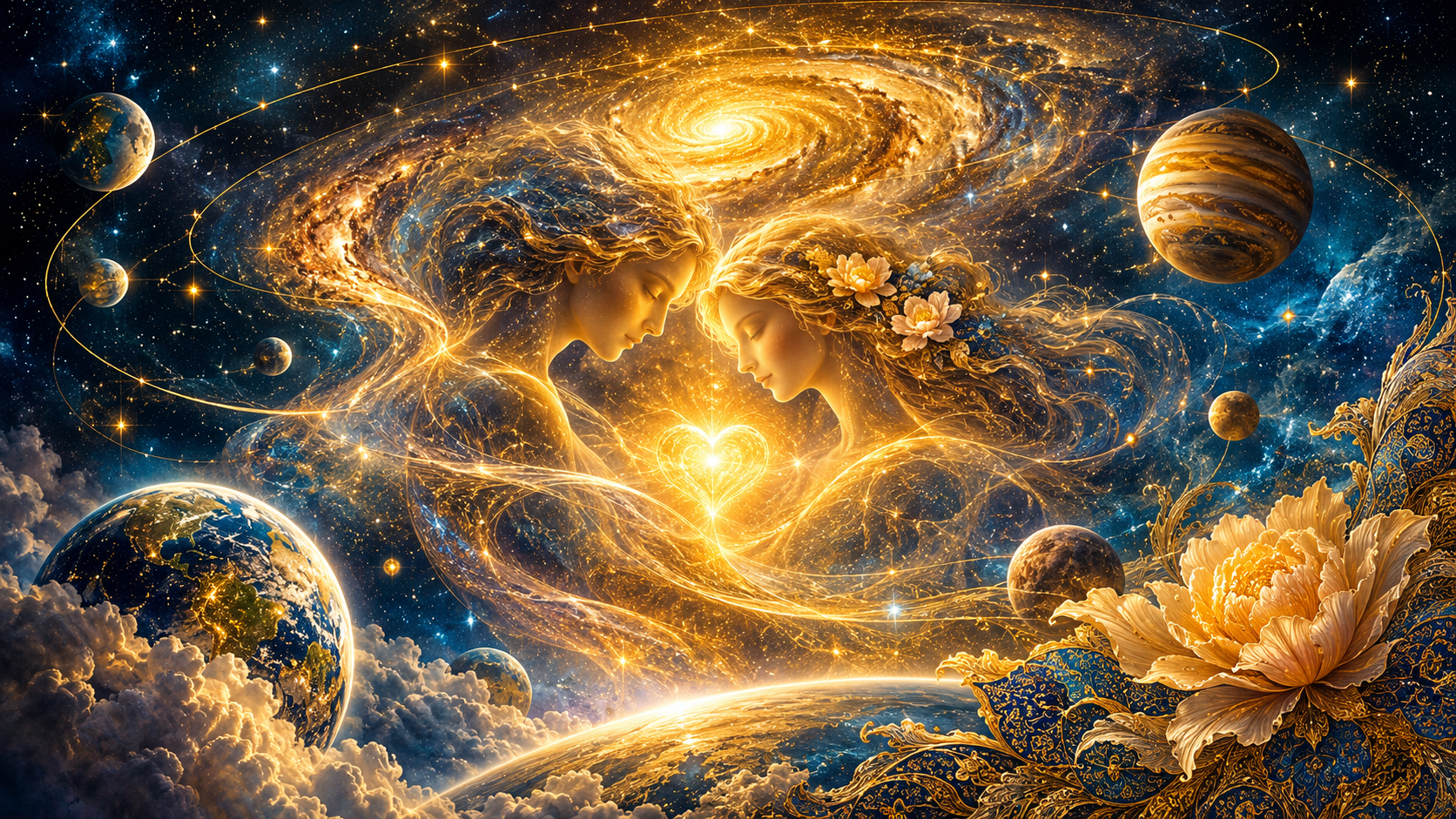
Is love more than an emotion? Explore love as a human way of recognising connection, creating meaning, and nurturing life through philosophy, nature, and art.
Explore the symbolic language of Persian art—from gardens and birds to miniature painting and geometric patterns—and discover how cultural meaning can inspire thoughtful contemporary design.
Explore love as an inner alchemy: a transformative force that deepens self-discovery, awakens compassion, and echoes through the mystical wisdom of Rumi.
A reflection on resilience, renewal, and the quiet courage of rising again after life's difficult chapters.