
Discovering the extraordinary principles of order, intelligence, and self-organization in the natural world.
Introduction: Nature Is More Organized Than It Appears
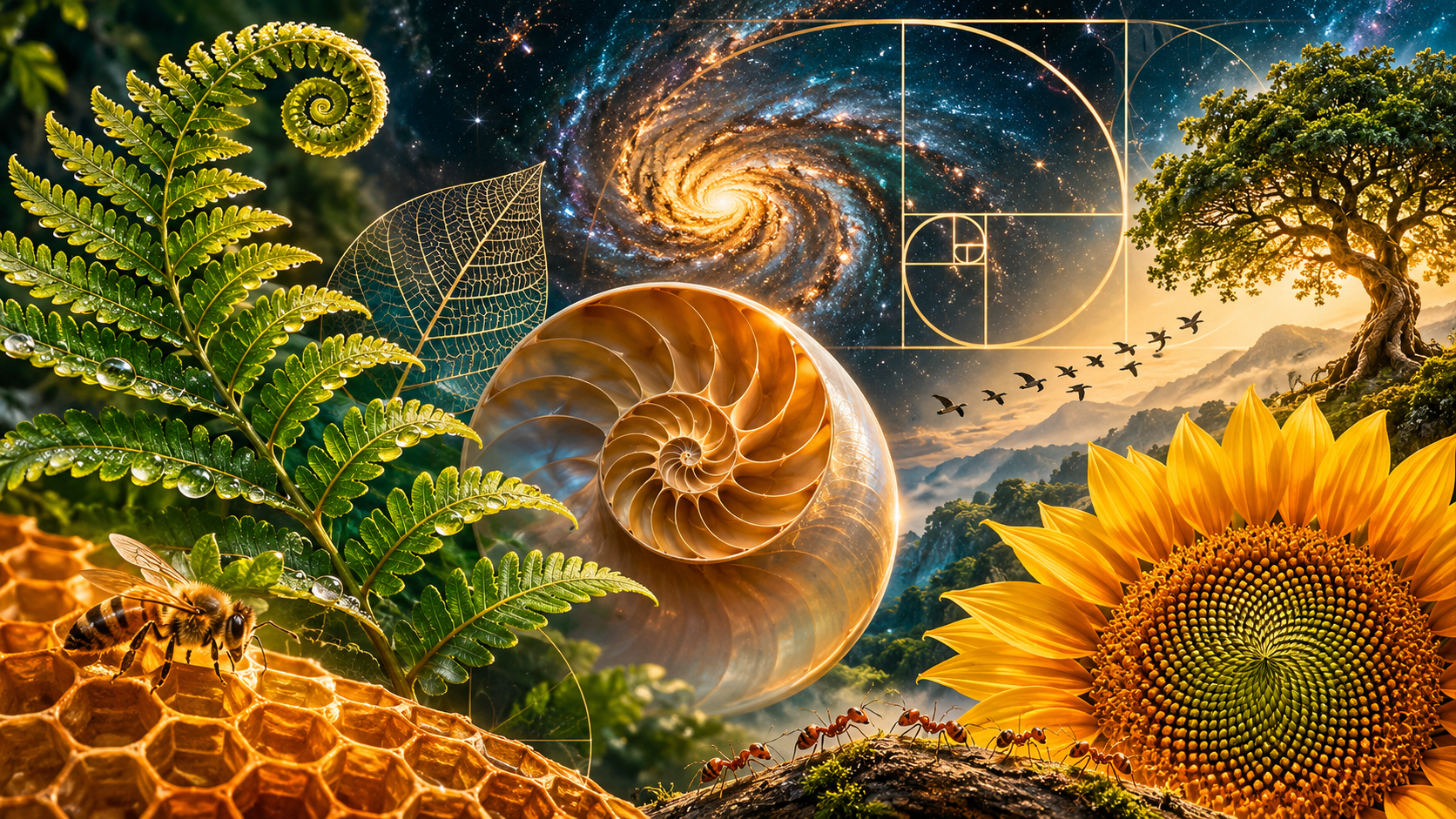
From the delicate structure of a fern leaf to the immense spiral of a galaxy, nature reveals patterns that repeat across different scales of existence. These patterns are not merely beautiful arrangements. They often reflect underlying mathematical principles, physical laws, and processes of self-organization.
Nature does not need a central architect to produce extraordinary complexity. Through simple interactions, countless living systems create structures that are remarkably coordinated, adaptive, and resilient.
Understanding these principles offers a new way to look at life itself.
1. The Geometry Hidden in Nature
One of the most fascinating features of the natural world is the repetition of geometric patterns.
Fractals appear in fern leaves, branching trees, river networks, coastlines, and even certain cloud formations. A fractal is a structure whose patterns repeat at different scales, creating complexity from relatively simple rules.
The Fibonacci sequence and the golden ratio also appear in several natural arrangements, including certain flower structures, seed patterns, and spiral formations.
These mathematical relationships reveal how geometry can become a language through which nature organizes form and growth.
2. Collective Intelligence: When Many Become One
Some of nature’s most remarkable achievements emerge from the cooperation of individual organisms.
Ant colonies organize complex activities without a single leader directing every movement. Bees communicate information about food sources through movement. Flocks of birds change direction with extraordinary coordination.
Scientists study these phenomena through concepts such as collective behavior and swarm intelligence.
The remarkable lesson is that complex coordination can emerge from simple local interactions. Intelligence, in these systems, is not always located in one individual. It can arise from the relationships between many individuals.
3. Self-Organization: Order Without a Central Designer
Nature frequently creates organized structures through processes of self-organization.
Snowflakes develop intricate symmetrical forms as water molecules freeze. Certain chemical systems produce repeating patterns. Ecosystems evolve through countless interactions between organisms and their environments.
Self-organization demonstrates that complexity does not always require centralized control.
Instead, order can emerge through interaction, feedback, adaptation, and the continuous exchange of energy and information.
4. Learning from Nature: From Biology to Technology
Human innovation has increasingly turned toward nature for inspiration.
This approach, known as biomimicry, studies natural structures and processes to develop solutions to human challenges.
Examples include:
- Architecture inspired by natural ventilation systems.
- Materials designed after the water-repellent properties of lotus leaves.
- Robotics inspired by the movement of animals.
- Efficient structures influenced by honeycomb geometry.
- Sustainable technologies inspired by ecosystems.
Nature is not simply a source of raw materials. It is also a vast library of tested principles and evolutionary solutions.
5. The Beauty of Connection
Perhaps the most profound discovery is that nature cannot be fully understood by examining its individual parts in isolation.
A forest is more than a collection of trees. An ecosystem is more than a collection of species. Every element participates in a network of relationships that influences the behavior of the whole.
This interconnectedness invites us to reconsider our relationship with the natural world.
Human beings are not separate observers standing outside nature. We are participants in the same interconnected systems that sustain life.
Conclusion: Reading the Patterns of Life
The hidden intelligence of nature is not necessarily a mysterious consciousness directing every leaf or creature. It is the extraordinary capacity of natural systems to generate complexity, coordination, and adaptation through fundamental principles.
By studying these patterns, we gain more than scientific knowledge. We discover new ways to design, build, create, and live.
Nature has been developing solutions for billions of years. Perhaps one of humanity’s greatest opportunities is learning how to understand its language.
Nature does not merely inspire creation. It reveals the principles through which creation becomes possible.
recent posts

Discover khatamkari, the intricate Persian art of geometric inlay, where wood, bone, and metal become finely balanced patterns through patience, precision, and skilled craftsmanship.

What lies beyond the reality we perceive? Explore the hidden mysteries of the universe, the limits of human knowledge, and the endless journey of discovery.

Discover why patience is more than waiting—and how time, awareness, and quiet perseverance shape a meaningful life.
Discovering the extraordinary principles of order, intelligence, and self-organization in ...

Love is more than an emotion. It is a transformative force that awakens creativity, expands awareness, and shapes who we are becoming.

Is love more than an emotion? Explore love as a human way of recognising connection, creating meaning, and nurturing life through philosophy, nature, and art.

Explore the symbolic language of Persian art—from gardens and birds to miniature painting and geometric patterns—and discover how cultural meaning can inspire thoughtful contemporary design.

Explore love as an inner alchemy: a transformative force that deepens self-discovery, awakens compassion, and echoes through the mystical wisdom of Rumi.

A reflection on resilience, renewal, and the quiet courage of rising again after life's difficult chapters.