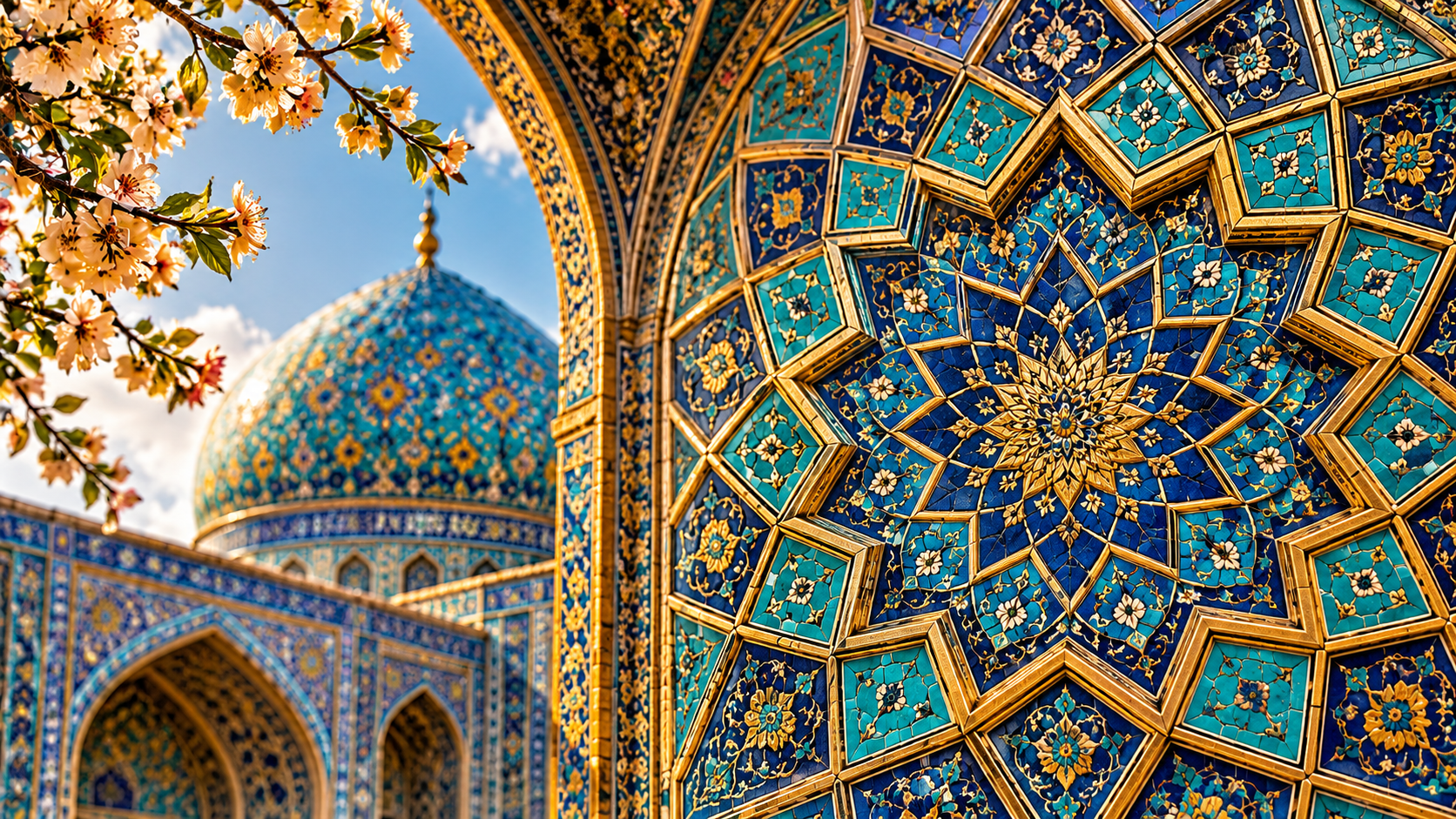
From the rhythm of a star-shaped tile to the balance of a garden pavilion, Persian geometry turns mathematical order into a language of beauty, meaning, and imagination.
More Than Decoration
Across Persian architecture and the decorative arts, geometry is rarely just an ornament added to an otherwise finished surface. It helps shape the experience of a place. Repeating stars, interlacing lines, polygons, and carefully balanced proportions guide the eye, create rhythm, and connect individual details to a larger visual whole.
In this tradition, a geometric pattern can be both precise and expressive. It demonstrates the intelligence of its maker while inviting the viewer to pause, observe, and discover relationships that may not be visible at first glance.
The Beauty of Order and Repetition
Many familiar patterns in Persian art are built from a small vocabulary of geometric elements: circles, polygons, stars, and intersecting lines. Through rotation, reflection, repetition, and proportion, these elements develop into intricate compositions.
The process is not simply about filling space. Repetition creates continuity; symmetry offers balance; variation prevents the design from becoming static. A successful composition allows every part to belong to the whole while retaining its own character.
Architectural surfaces, tilework, carved details, woodwork, metalwork, and manuscript decoration each provide different opportunities to explore this visual language. The material changes, but the underlying search for harmony remains.
Geometry in Persian Architecture
In Persian architectural environments, geometric design often works alongside calligraphy, floral ornament, colour, light, and architectural structure. On a tiled wall or beneath a dome, patterns can transform a surface into an ordered field that seems to extend beyond its physical boundaries.
Designers and craftspeople had to consider more than the appearance of a finished pattern. They needed to understand measurement, proportion, material behaviour, the placement of individual pieces, and how a design would meet corners, borders, arches, or curved surfaces.
This union of intellectual planning and practical skill is one reason geometric ornament remains such a powerful expression of craftsmanship.
A Visual Language of Connection
Interlacing patterns offer a particularly compelling experience. Lines pass over and under one another, shapes meet and separate, and the eye moves through the composition without finding a single point that explains everything.
It is tempting to assign one fixed spiritual meaning to every star, circle, or polygon. Yet symbols in historical art do not always carry one universal interpretation. Their meanings can depend on context, place, period, patronage, and the relationship between geometry and other decorative elements.
What can be appreciated without overstating the symbolism is the way these patterns make connection visible: one shape leads to another, separate parts form a coherent system, and complexity emerges from a disciplined set of relationships.
Where Mathematics Meets the Human Hand
Geometric art brings abstract thinking into contact with physical materials. A design may begin with a measured grid or a carefully constructed set of divisions, but its final expression depends on the craftsperson’s hand, judgement, and patience.
Tiles must align. Edges must meet. Repeated elements must remain consistent while adapting to the dimensions of a real surface. The smallest error can disturb the rhythm of the whole composition.
This is where technical knowledge becomes artistic intelligence. Mathematics provides structure; craftsmanship gives that structure presence, texture, and life.
The Impression of Infinity
Some repeating geometric compositions seem capable of continuing beyond the frame. Even when a pattern is contained within a doorway, a panel, or a dome, its visual logic suggests a larger order.
This impression of continuity is one of the most captivating qualities of geometric ornament. The viewer sees a finite arrangement while imagining how its underlying rhythm might extend. It is an artistic effect created through repetition, connection, and careful control of space—not a claim that every pattern has the same symbolic meaning.
Lessons for Contemporary Design
Persian geometric traditions offer valuable lessons for contemporary creativity. They show how a limited set of elements can generate remarkable variety, how consistency can coexist with invention, and how ornament can strengthen rather than distract from a design.
For modern product design, architecture, jewellery, textiles, and visual identity, the goal should not be to copy historical motifs without understanding them. A more meaningful approach begins by studying their construction: the relationships between shapes, the logic of repetition, the balance of empty and filled space, and the way a pattern responds to its material.
These principles can then be reinterpreted with new technologies and contemporary forms while respecting the knowledge carried by the original craft traditions.
Keeping a Living Heritage
Heritage remains alive when knowledge is studied, practised, shared, and thoughtfully renewed. Preserving geometric art therefore involves more than photographing historic buildings. It also means valuing skilled makers, documenting techniques, supporting education, and creating opportunities for new generations to work with these ideas.
At Gold & Luxe, we see Persian geometry as more than a visual reference. Its discipline, ingenuity, and expressive potential can help shape contemporary creations with a distinctive cultural identity. The aim is not to imitate the past, but to carry its intelligence into the future.
More Than a Pattern. A Language of Harmony.
Read this article in Persian: زبان پنهان هندسه ایرانی؛ جایی که هنر به بینهایت میرسد
Gold & Luxe Journal — Heritage, Art & Culture.
recent posts
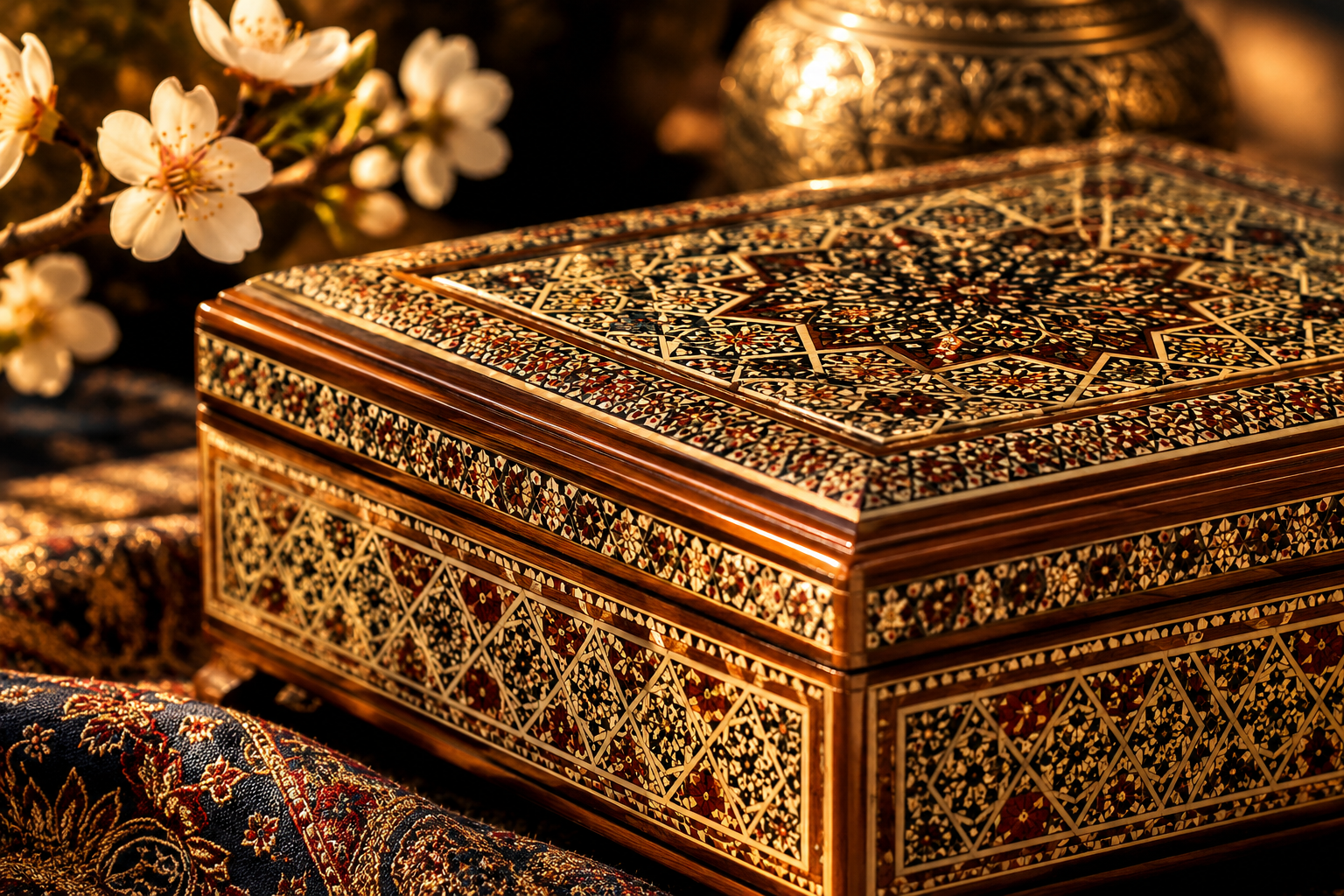
Discover khatamkari, the intricate Persian art of geometric inlay, where wood, bone, and metal become finely balanced patterns through patience, precision, and skilled craftsmanship.

What lies beyond the reality we perceive? Explore the hidden mysteries of the universe, the limits of human knowledge, and the endless journey of discovery.
Discover why patience is more than waiting—and how time, awareness, and quiet perseverance shape a meaningful life.
Discovering the extraordinary principles of order, intelligence, and self-organization in ...
Love is more than an emotion. It is a transformative force that awakens creativity, expands awareness, and shapes who we are becoming.

Is love more than an emotion? Explore love as a human way of recognising connection, creating meaning, and nurturing life through philosophy, nature, and art.
Explore the symbolic language of Persian art—from gardens and birds to miniature painting and geometric patterns—and discover how cultural meaning can inspire thoughtful contemporary design.
Explore love as an inner alchemy: a transformative force that deepens self-discovery, awakens compassion, and echoes through the mystical wisdom of Rumi.
A reflection on resilience, renewal, and the quiet courage of rising again after life's difficult chapters.