
We often call something chaotic when we cannot see the pattern that connects its parts. A storm appears disorderly, a forest seems untamed, and the night sky can look like an immense scattering of distant lights. Yet when we look more closely, nature reveals recurring forms, relationships, rhythms, and structures. The question is not whether every event follows a hidden plan. It is whether reality contains more layers of order than our everyday perception allows us to notice.
When chaos becomes a question
Human beings have always searched for patterns. We connect stars into constellations, recognize faces in clouds, and look for causes behind events. This instinct can help us understand the world, but it can also mislead us: not every resemblance is meaningful, and not every coincidence points to a design. A thoughtful exploration of the universe must hold wonder and skepticism together.
In science, chaos does not simply mean randomness. Chaotic systems can follow precise rules while remaining extraordinarily sensitive to their starting conditions. A tiny difference at the beginning may lead to a very different outcome later. Weather is a familiar example: its behavior is governed by physical processes, yet long-term prediction becomes difficult because small variations can grow.
Here is the first remarkable distinction: something can be lawful without being easily predictable. What looks like disorder from a distance may arise from relationships that are intricate, dynamic, and difficult to follow.
Nature writes in recurring forms
Look at the branching of trees, the veins of a leaf, the branching paths of rivers, or the delicate structure of a snowflake. These forms are not identical, yet many share principles of growth, repetition, adaptation, and efficiency. Across very different scales, nature often arrives at shapes that echo one another.
Fractal geometry offers one way to describe some of these patterns. A fractal is a structure in which similar forms can appear at different scales. Not every natural object is a perfect mathematical fractal, but coastlines, clouds, plants, and branching networks can display fractal-like qualities. Their beauty is not merely decorative; their forms often emerge from the physical conditions under which they grow.
Such patterns invite us to reconsider the boundary between simplicity and complexity. A relatively small set of processes can generate astonishingly varied results. Complexity does not always require a central architect directing every detail.
The intelligence of self-organization
In many systems, order can emerge through local interactions. Birds in a flock respond to nearby birds; individual movements combine into coordinated motion. Ant colonies build and maintain elaborate networks without a single ant possessing a complete map of the whole. In chemistry, physical and chemical interactions can produce organized structures under suitable conditions.
Scientists use the term self-organization to describe forms of order that arise from interactions within a system rather than from a single external controller. The process can be astonishing, but it does not necessarily imply consciousness, intention, or a universal mind. It shows that organization can emerge from relationships and rules operating at many levels.
Perhaps this is one of the most useful meanings of the phrase “invisible intelligence”: not a proven hidden thinker behind every event, but the remarkable capacity of nature to produce structure through interaction.
From galaxies to the living cell
On the largest scales, gravity gathers matter into stars, galaxies, and vast cosmic structures. On smaller scales, chemistry allows atoms to form molecules, and under the right conditions, complex networks of reactions can support living systems. These are different processes, governed by different mechanisms, but together they remind us that the universe is not a featureless emptiness. It is a place where matter can organize, transform, and create new possibilities.
Science describes many of these processes with extraordinary precision. It does not, by itself, settle every philosophical question about why there is a universe at all, why its laws take the forms they do, or what meaning human beings may find within it. Those questions belong to an ongoing conversation between scientific inquiry, philosophy, and human experience.
Does order mean purpose?
It is tempting to move from the discovery of patterns to the conclusion that everything must have been arranged for a purpose. But order and purpose are not the same thing. A spiral galaxy, a branching river, and a growing crystal can display structure without that structure proving intention. Scientific explanation asks how processes work; philosophical reflection can ask what their existence means to us. Confusing these questions may weaken both.
We can remain open to mystery without turning mystery into evidence. We can appreciate the elegance of natural laws without claiming that science has confirmed a cosmic plan. Intellectual humility does not diminish wonder; it gives wonder a more honest foundation.
Learning to see beyond appearances
Perhaps the deepest change begins not in the universe, but in the way we observe it. When we pause before calling something meaningless or chaotic, we make room for a more patient kind of attention. We look for relationships, context, scale, and the conditions that shaped what we see.
Artists have long understood the power of this attention. A miniature painting can reveal a world within a small space; a geometric pattern can turn repetition into rhythm; a poem can bring distant ideas into a single image. Art does not replace scientific explanation. It can, however, train us to notice connections and to feel the depth of what might otherwise pass unseen.
The question behind the pattern
The universe does not disclose all its secrets at once. Some of its structures can be measured, modeled, and tested. Others remain questions at the edge of what we know. Between certainty and mystery lies a vast space for careful thought.
Maybe the most meaningful discovery is not that every event hides a predetermined design, but that reality is richer than first impressions suggest. What appears fragmented may be connected by processes we have yet to understand. What seems silent may still be full of relationships.
If the universe can create such extraordinary forms from simple interactions, what might we learn by looking more patiently at the patterns shaping our own lives?
recent posts
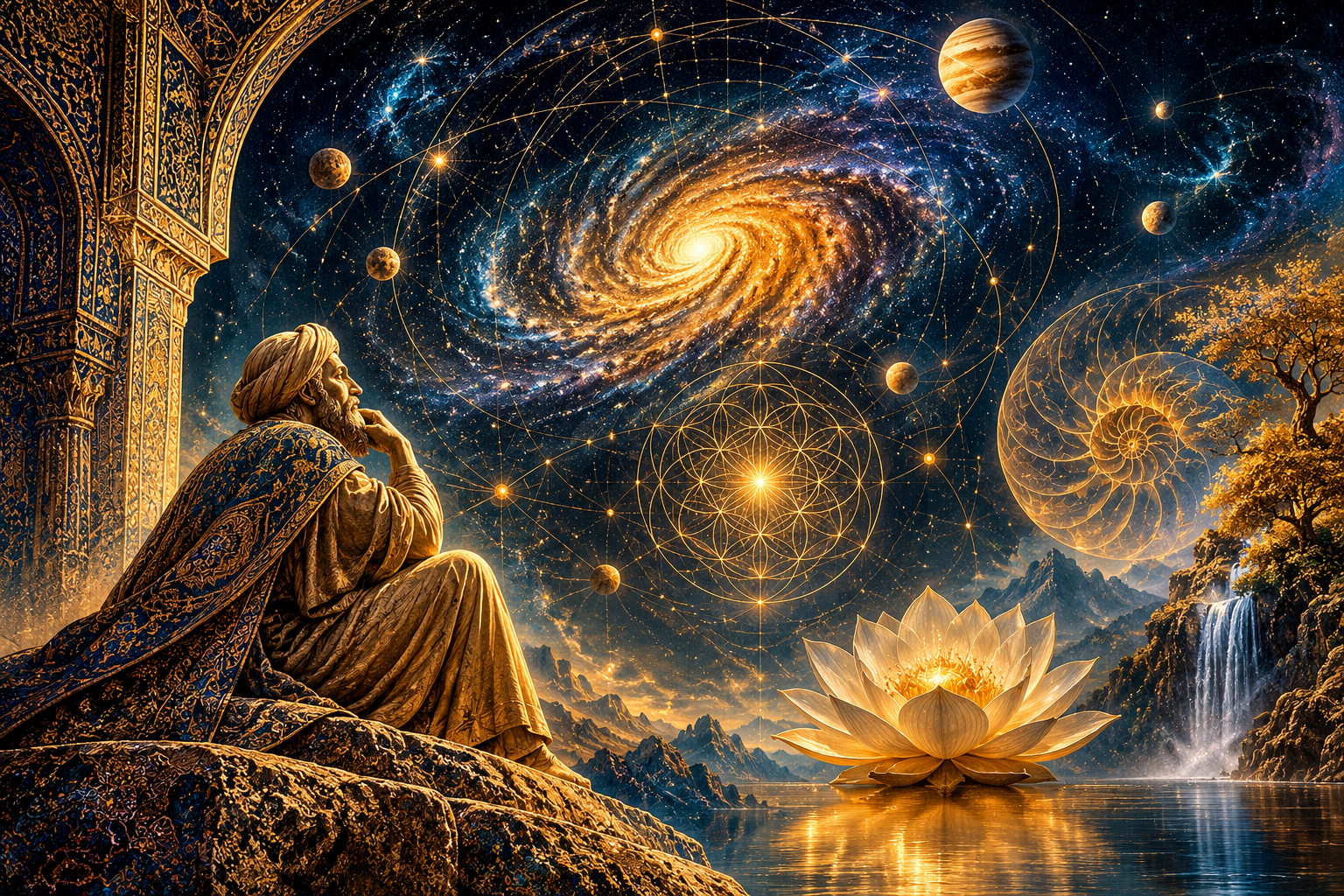
From fractal patterns in nature to the formation of galaxies, the universe reveals structures that invite a profound question: how much order exists beneath what we perceive as chaos?

Beyond the absence of sound lies a hidden language. Explore silence through Persian architecture, philosophy, art, and human awareness.

Discover khatamkari, the intricate Persian art of geometric inlay, where wood, bone, and metal become finely balanced patterns through patience, precision, and skilled craftsmanship.
What lies beyond the reality we perceive? Explore the hidden mysteries of the universe, the limits of human knowledge, and the endless journey of discovery.
Discover why patience is more than waiting—and how time, awareness, and quiet perseverance shape a meaningful life.
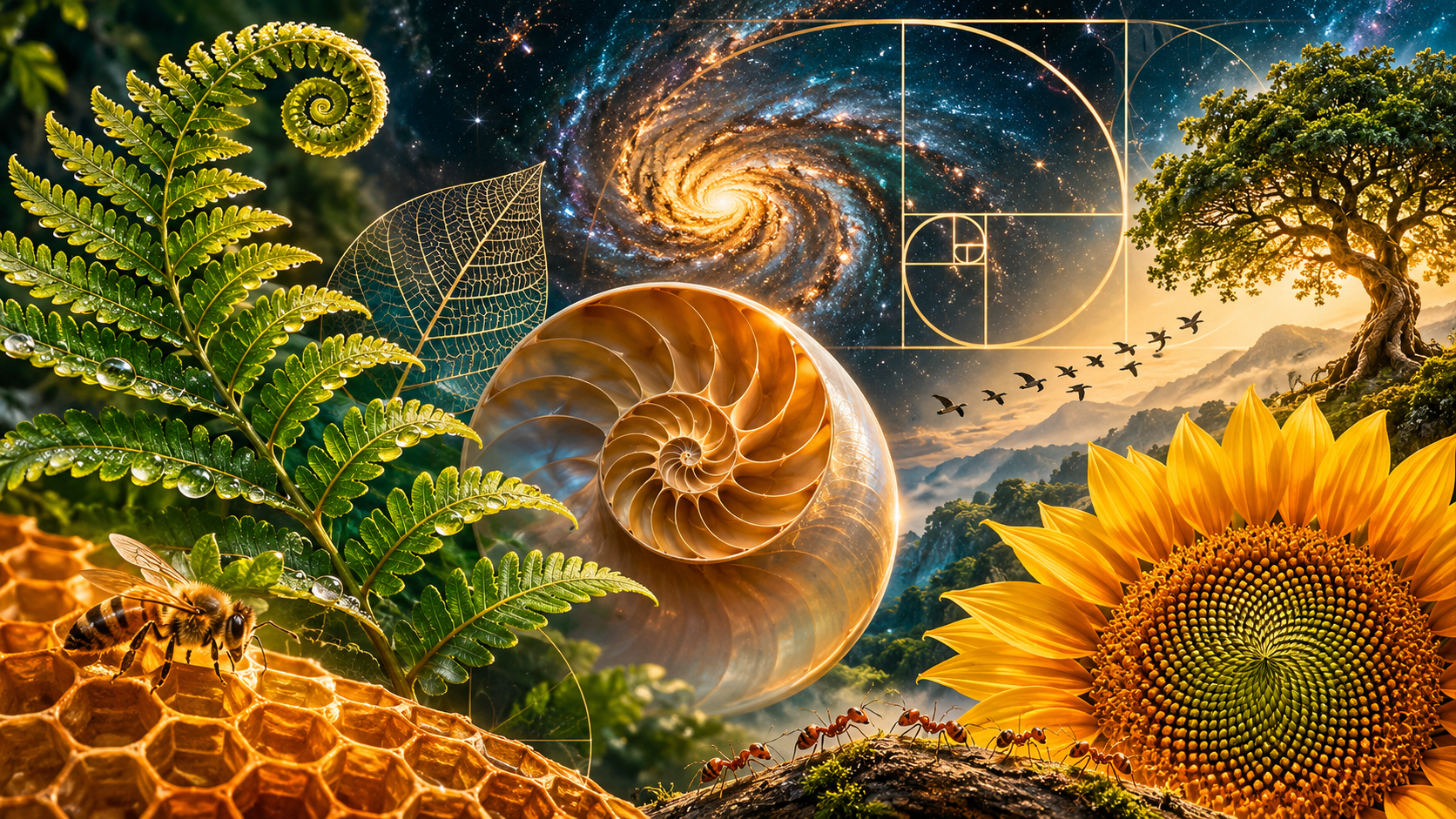
Discovering the extraordinary principles of order, intelligence, and self-organization in ...

Love is more than an emotion. It is a transformative force that awakens creativity, expands awareness, and shapes who we are becoming.
Is love more than an emotion? Explore love as a human way of recognising connection, creating meaning, and nurturing life through philosophy, nature, and art.
Explore the symbolic language of Persian art—from gardens and birds to miniature painting and geometric patterns—and discover how cultural meaning can inspire thoughtful contemporary design.